Heels4Pads Foundation Redefines Feminine Hygiene Advocacy in Africa
Angela, thank you for joining us. Tell us about yourself and how the Heels4Pads Foundation came to be.
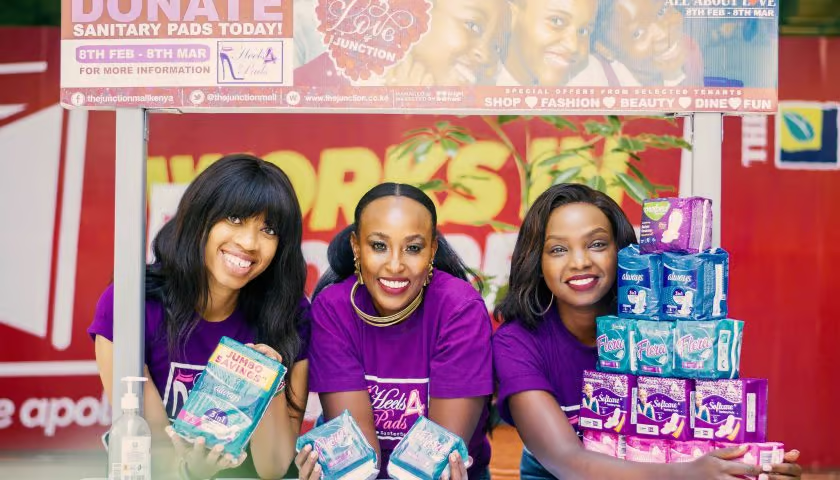
Thank you for having me. I am the co-founder of the Heels4Pads Foundation, and empowering girls is at the heart of everything I do. The idea for Heels4Pads came from my co-founder, Monicah Muhoya, whose work with homeless communities exposed her to the harsh realities of period poverty. During one of her annual spring cleanings, she approached me and our third co-founder, Angela Wambui, with a unique barter-trade idea; instead of discarding high heels we no longer wore, why not use them as currency? We would collect donated heels, sell them, and use the proceeds to buy sanitary pads for girls and women in need.
We immediately loved the idea and recognized its potential as a tangible CSR initiative under SisterSpeaks Global, a women-centered empowerment platform that provides safe spaces for women to connect and grow personally and professionally.
We met on May 10th, 2019, at a coffee shop in Nairobi, coined the name Heels4Pads, and launched the digital campaign just three days later. What began as a simple social media initiative quickly gained momentum, eventually earning recognition from Miss World Kenya, Maria Wavinya, who selected Heels4Pads as her Beauty with a Purpose organization. That milestone led to our formal registration as a foundation.
The Heels4Pads model is both creative and community-centered. What has been the most fulfilling part of seeing it in action over the years?
The most fulfilling part has been watching a simple idea transform into a tangible force for dignity. Over the past six years, we’ve reached more than 25,000 girls and women across 19 counties. But beyond the numbers, the true fulfillment lies in the depth of that impact, like seeing our six Adopt A Dispenser pad ATMs in schools ensure that a girl’s education is never interrupted by her period. It’s also in the shift we witness when conversations about menstruation are met with knowledge rather than shame.
A particularly proud moment came last year when we introduced self-learning booklets for the girls, helping them understand both girls’ and boys’ puberty journeys so they can continue learning about their growth. We’ve also begun holding sessions with boys to address stigma and foster open dialogue around menstrual health. Seeing that inclusive change unfold has been truly inspiring.
From your experience, what does menstrual poverty look like in Kenya and Africa today?
Menstrual poverty in Kenya and across Africa is not merely a lack of products, but a crisis of dignity and opportunity that fuels deep-rooted gender inequality. It shows up in heartbreaking ways: girls resorting to unsafe, unhygienic materials like rags, newspaper, or even sand, exposing them to health risks and immense shame.
It is estimated that about 65% of women and girls in Kenya lack access to affordable menstrual products. A commonly cited UNICEF statistic suggests that 1 in 10 girls in Africa misses school because of her period. Each missed school day widens the educational gap between girls and boys, reinforcing cycles of inequality that limit a girl’s future opportunities and economic potential.
But beyond the numbers are human stories that continue to shape our mission. One that revealed how intertwined these challenges are came from a pastoralist community in Samburu. We learned of a girl, only eight or nine years old, who walked 42 kilometers to escape becoming a child bride after she started her period. Her story was a devastating reminder that period poverty is often a trigger point, linked to child marriage, Female Genital Mutilation (FGM), and even sexual abuse.
However, the story that truly solidified our resolve was that of Jackline Chepngeno, a schoolgirl who tragically took her own life after being publicly shamed by her teacher for staining her uniform. The humiliation and bullying that followed drove her to despair. For us, Jackline’s story underscored that no child should ever feel that suicide is the only escape from period shame. It was a heartbreaking, preventable tragedy, and a stark reminder that our work is not just about distributing pads, but about defending a girl’s dignity, education, and right to life itself.
These are really heartbreaking stories. In your opinion, how have traditional beliefs and cultural taboos shaped menstrual conversations in African societies, and how is that changing as advocacy grows?
Traditional beliefs and cultural taboos have historically confined menstruation to the shadows across many African societies. It has been treated as an impurity and a source of shame. This has dictated that it be a strictly private affair, a conversation held only between women, which has systematically excluded men and boys from understanding it, thereby perpetuating the cycle of stigma and silence.
The Northern regions of Kenya, including pastoralist and arid communities, present some of the most complex challenges. There, period poverty is deeply interwoven with harmful traditional practices like FGM and child marriage. A girl’s first period is often seen as a signal that she is ready for marriage, making menstruation a trigger point for life-altering, and usually traumatic, events. These deeply entrenched, intergenerational norms make it difficult to address period poverty in isolation.
However, we are seeing a decisive shift. Changing generational attitudes, accelerated by urbanisation and the reach of social media, are beginning to dismantle these taboos. In urban areas, there is more openness, though the private nature of the conversation persists. Crucially, social media and digital campaigns are creating new, public forums for education that allow us to intentionally bring men into the conversation, demystifying menstruation and reframing it as a shared human issue, not just a “women’s issue.”
Ultimately, we must all realise a simple truth: every single one of us is a product of a woman who missed her period. This is not a niche issue; it is a human one. Our mission is to own this reality collectively, work together to raise awareness, and create sustainable solutions that ensure no girl is held back by something so natural.
Looking ahead, what needs to change most urgently in Kenya’s menstrual health advocacy: in policy, mindset, or community action?
I hope we stop talking about “menstrual health” as a standalone issue and start recognising it as a core part of human dignity, gender equality, and economic strategy.
In Policy: Kenya’s free pads policy was a great start, but it falters due to inconsistent funding and weak enforcement. What we need now is a sustained, nationwide rollout that integrates menstrual health into the broader Water, Sanitation, and Hygiene (WASH) framework.
In Mindset: We must dismantle the idea that menstrual health is a “women’s issue.” This is why we welcome opportunities to involve men in the conversation. Platforms like ManTalk Ke have shown how transformative that can be.
I would love to see Kenya emulate countries that inspire us on different aspects of menstrual equity. For example:
- Scotland became the first country to legally guarantee free, universal access to period products, showing that menstrual care is a public health right, not a privilege.
- South Africa removed the “tampon tax” years before Kenya, and Rwanda has a zero-rated VAT on sanitary products, demonstrating a commitment to economic accessibility.
- Uganda and Tanzania explicitly link school WASH facilities to menstrual health, acknowledging that pads alone are insufficient without clean water, privacy, and safe disposal.
Kenya has laid the groundwork through progressive policy. The challenge now is not whether to act, but how to implement these policies effectively, consistently, and holistically. The next frontier is to move from a product-centric model to a dignity-centric one that fully recognises menstrual health as integral to our nation’s development.
How have like-minded organizations and private-sector partners helped you expand your reach and impact?
There is a growing ecosystem around menstrual health and dignity that truly inspires us. We often collaborate with organizations that share our mission to multiply our impact, including Together For Better Foundation, Mina Foundation, and Aguko Foundation. These partnerships have expanded our reach and strengthened our collective voice. We’ve also worked with private-sector partners such as Nissan Kenya, Deloitte, and KPMG, showing how corporate social responsibility can drive tangible, holistic change. The media also accelerates progress by breaking the silence and normalizing menstrual conversations. Our features across local outlets have brought this issue into living rooms and community spaces.
Lastly, how does your Christian faith intersect with your advocacy for girls and women?
My Christian faith is the bedrock of my work. It is the source of the belief that every single person is created in the image of God and possesses inherent, unshakeable dignity. This is non-negotiable.
Therefore, our work is not just charity; it is a ministry of restoration. When we fight period poverty, we are restoring the dignity that poverty and stigma have stolen. When we empower a woman survivor of GBV through our Dignity and Dreams Academy (D.A.D.A.), we affirm her God-given purpose and potential. My faith demands that I approach every girl, every woman, and even every skeptic with compassion, seeing them as God sees them: whole, worthy, and loved. This shapes our entire model. It’s why we don’t just hand out pads; we build circles of support that restore confidence and purpose.
This is a perfect way to end this interview. In closing, what can we all do to move the needle on this issue?
If I could leave your audience with one thought, it would be this: period poverty is a solvable problem. Everyone has a role to play:
- Donate: A single pair of heels can fund a year’s supply of pads for a girl.
- Advocate: Ask your leaders about the enforcement of free pad policies in your local schools.
- Educate: Talk openly about periods with the boys and girls in your life, because awareness breaks stigma.
We have donation collection points at all IKOJN stores, Yaya Centre, Greenhouse Mall, and Imaara Mall. Additionally, on the first and last weekends of every month (Friday to Sunday), we host a drop-off station at The Junction Mall.
Monetary donations can be made via Paybill 542542, Account No. 530300, or through our GoFundMe at https://www.gofundme.com/f/heels4pads-initiative.
We invite everyone to join us. Visit heels4pads.org to learn more and explore partnership opportunities. Together, we can ensure that every girl stands tall and proud, free from the limitations of poverty and shame.
Sign up to receive our email newsletters with the latest news updates and insights from Africa and the World HERE.