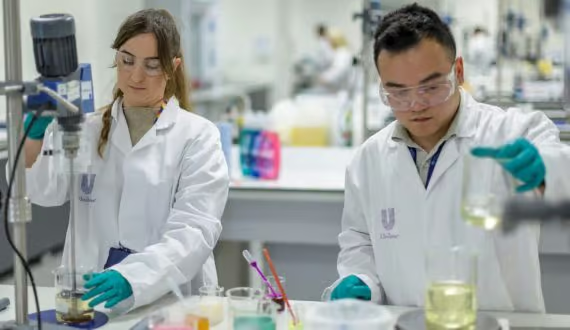
Unilever invests USD 39.3M to upgrade Indian research hubs with AI
This move strengthens capabilities spanning consumer research, scientific discovery, product design, prototyping and manufacturing scale-up.

INDIA – Unilever is investing an additional €35 million (USD 39.32 million) to transform its research and development centres in Mumbai and Bangalore into a more connected, AI-led innovation network.
The investment will establish Mumbai as a Product Innovation Centre while further developing Bangalore as a global science, technology and partnership hub.
Richard Slater, Unilever’s Chief Research & Development Officer, said the changes are intended to help the company turn scientific advances into improved products more quickly and strengthen its research capabilities for the future.
The plans also include a €5 million (USD 5.62million) commitment over five years to establish a strategic Bio-Futures Partnership focused on human biology, microbiome science, biotechnology and biomanufacturing.
The announcement does not explicitly specify whether that commitment forms part of the €35 million investment or is separate from it.
According to Slater, the additional €35 million (USD 39.32 million) will expand capabilities Unilever has developed in recent years, including its Liquids Lab of the Future, Unilever Fragrance House, Advanced Manufacturing Centre for soap bars, Packaging and Flexibles Design Lab, and AI and digital modelling platforms.
The company has already invested more than €20 million (USD 22.47 million) over the past five years in these capabilities.
Its existing Mumbai and Bangalore centres combine consumer understanding with scientific research, automation, predictive modelling and rapid prototyping to support product development.
With the Indian centres closely connected to Unilever’s global R&D network, their work is expected to support innovation across Beauty, Wellbeing, Personal Care, Home Care and other parts of the business.
Mumbai to integrate product development under one roof
The Mumbai site will become a Product Innovation Centre that brings together activities involved in developing products, from identifying consumer needs to preparing innovations for large-scale manufacturing.
The centre will combine consumer insights, new measurement approaches, product and format science, packaging design, rapid prototyping and scale-up capabilities within a single environment.
The intended change is not simply to expand individual laboratories, but to connect disciplines that can otherwise operate in different locations and at different stages of development.
Scientists, product developers, designers and digital specialists will work alongside one another, bringing consumer understanding and scientific discovery into closer contact.
Across both locations, Unilever plans to use AI, automated experimentation, predictive modelling and digital twins to help researchers investigate more possibilities and identify promising approaches more quickly.
The company’s aim is to connect the stages of development more closely: understanding a consumer need, establishing the science, designing a product, producing prototypes, testing performance and determining how to manufacture at scale.
By bringing these capabilities together, Unilever expects to reduce the separation between discovery and development and move promising concepts towards scalable products with greater speed and precision.
For Dove Hair Care, Slater highlighted Peptide Bond Strength Technology, which he described as going beyond surface treatment to help reconstruct bonds within damaged hair. According to his account, consumers can see and feel benefits from the first wash.
The broader objective of the investment, he said, is not merely to perform today’s R&D tasks faster. It is to expand what Unilever’s scientists can create, opening up possibilities for next-generation products and innovations that existing approaches could not deliver.
Sign up to receive our email newsletters with the latest news updates and insights from Africa and the World HERE.