Researchers unveil AI-powered self-driving lab for heat-resistant coatings
The innovation support higher-throughput development of advanced coatings in the future.
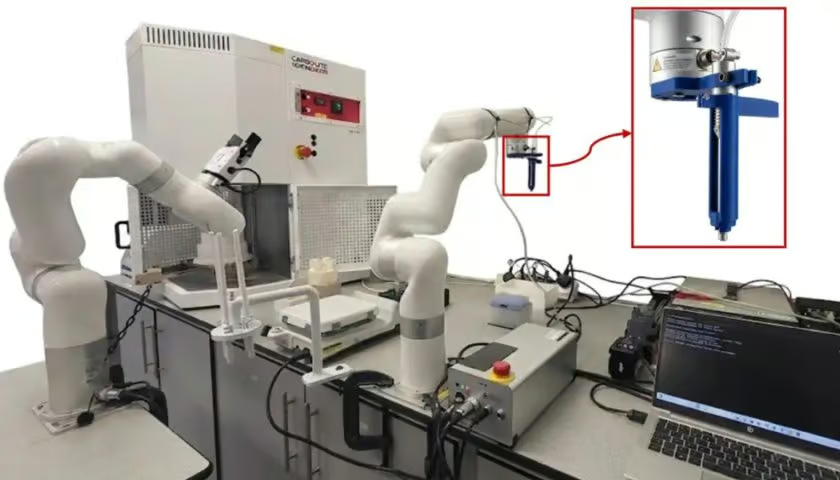
UK – Researchers at the University of Nottingham have created a self-driving laboratory that uses artificial intelligence and robotics to streamline the search for heat-resistant coatings.
By combining automated liquid dispensing, robotic material handling, and high-temperature furnace processing in one system, the platform supports the development of next-generation thermal barrier coatings for aerospace and energy applications.
The Centre of Excellence in Coating and Surface Engineering (CE-CSE) at the University of Nottingham built the laboratory to automate the creation of advanced materials intended for extreme operating conditions.
It combines two robotic arms, a custom liquid-dispensing tool, laboratory equipment, and purpose-built software to manage the entire experimental process, from precisely measuring and mixing chemicals to furnace treatment and retrieving finished samples.
Traditionally, developing materials for harsh environments requires repeated manual work, including preparing samples, processing them at high temperatures, and testing their properties.
By coordinating these steps within a single automated workflow, the Nottingham team seeks to reduce the need for human intervention while improving consistency and reproducibility across experiments.
The system uses an artificial-intelligence method called active learning, which draws on results from earlier experiments to select the most promising material compositions for further testing.
Using this approach, researchers identified and prepared several candidate materials with a pyrochlore crystal structure for assessment as possible thermal barrier coatings.
These coatings function as protective heat shields in aerospace engine components exposed to extreme temperatures.
Finding materials with low thermal conductivity is therefore an important step toward improving thermal protection and enabling more durable, high-performance engine components.
Although robots are increasingly common in laboratories, reliably linking chemical preparation, sample handling, and high-temperature furnace processing has remained a major technical hurdle.
Calibration tests showed that the system could dispense different fluids accurately, while the integrated workflow successfully prepared a precursor solution, transferred it for furnace processing, controlled cooling, and retrieved the treated sample without human involvement.
Professor Tanvir Hussain, Professor of Coatings and Surface Engineering, said the research addresses a key element of the wider challenge of dependable multi-stage automation.
He noted that it also creates opportunities to integrate the system more deeply with intelligent experimental planning.
The development reflects a broader move toward digitalisation in coatings research and manufacturing.
The European Coatings’ Digitalisation in Coatings Formulation conference, scheduled for 1–3 December 2026 in Amsterdam, will examine AI-assisted formulation, automated testing, process optimisation, digital quality control, data integrity, and secure digital workflows across the coatings value chain.
Sign up to receive our email newsletters with the latest news updates and insights from Africa and the World HERE.